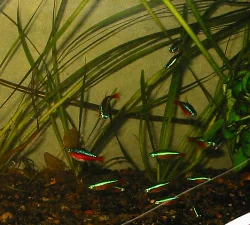
The Cardinal Tetra is ideal as a schooling fish together with South American cichlids like Pterophyllum scalare. A large school of Cardinal Tetras swimming around a pair of fully grown Angelfish is one of the most beautiful sights in a South American community tank.
Natural Habitat and Water Parameters
Paracheirodon axelrodi originates from the upper Rio Negro and Orinoco basins. In the wild, they inhabit 'blackwater' streams, stained by tannins from decaying organic matter. This water is extremely soft and acidic (pH as low as 4.0-5.5). In the home aquarium, they thrive best at temperatures between 24-28°C. To see their colors at their most vibrant, a dark substrate and plenty of bogwood are highly recommended.
Behavior and Social Life
They are quintessential schooling fish and should be kept in groups of at least 10 individuals, though larger groups are always better. They are peaceful and compatible with most calm species. However, as I have personally experienced, one must be cautious with large cichlids. While they look stunning with Angelfish, fully grown angels often perceive small tetras as a natural food source.
My Cardinal Tetras
To begin with, I bought 10 Cardinal Tetras and some months later, 10 more. At that time, the Angelfish in the tank had become so large that they perceived the smallest tetras as a somewhat expensive food supplement. Consequently, I lost about half of them shortly after purchase. Later, I bought a school of 25 fish for my 325-liter community tank, where they lived alongside my 'red shoulder' angels and various other schooling fish.
Breeding
Breeding the Cardinal Tetra is considered one of the most difficult challenges in the hobby. They require extremely clean, bacteria-free, and very soft water, and the eggs are light-sensitive. Once I have gained enough experience with other characins, I intend to try breeding them, but it is not a task to be taken lightly.
Status
Currently, I don't have any Cardinal Tetras, but I am certain I will get some again. To me, they remain one of the 5-10 iconic species that symbolize the aquatic hobby.